

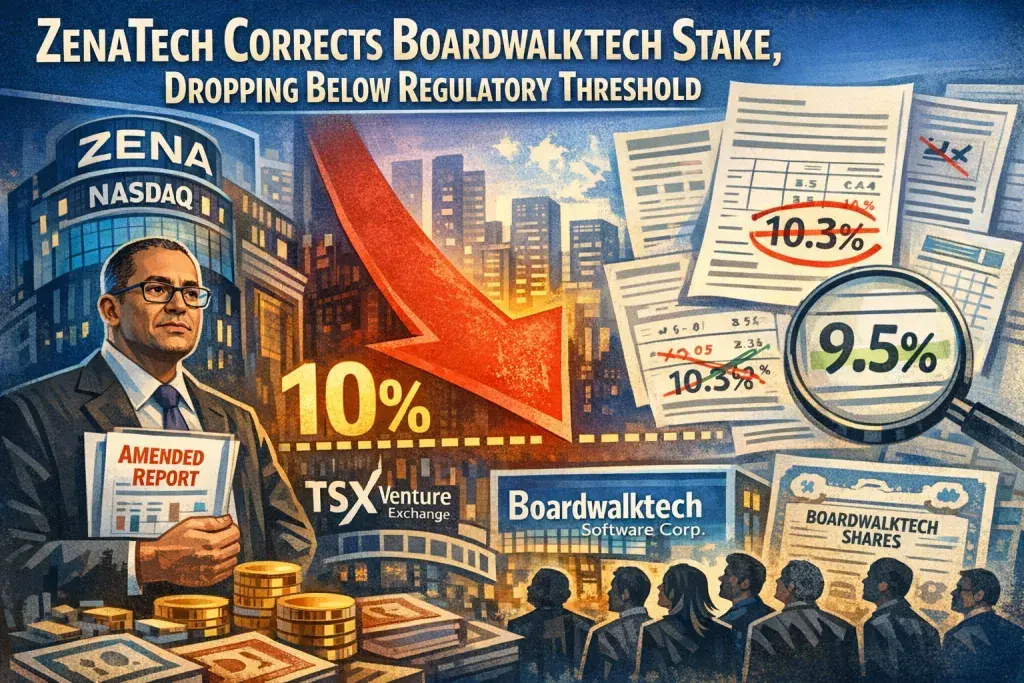
A miscalculation in share totals briefly placed ZenaTech, Inc. above the ownership level that triggers mandatory securities disclosures in Canada — but the NASDAQ-listed technology company has now corrected the record. ZenaTech announced Sunday that its combined stake in Boardwalktech Software Corp., when properly measured against the company's full share count, falls below 10%, eliminating the need for an Early Warning Report under applicable securities law. The correction follows an initial disclosure on April 13, 2026, in which ZenaTech reported acquiring 6,744,000 common shares of Boardwalktech on the TSX Venture Exchange.
What the Numbers Actually Show
ZenaTech purchased its Boardwalktech shares at prices ranging from $0.035 to $0.05 per share — a price range reflecting Boardwalktech's position as a micro-cap company trading on the TSX Venture Exchange, Canada's market for earlier-stage and smaller public companies. ZenaTech's Chief Executive Officer, Dr. Shaun Passley, separately acquired 500,000 shares in the same price range, bringing the combined holding to 7,244,000 shares.
The initial calculation placed that combined position at approximately 10.3% of Boardwalktech's issued and outstanding common shares. The error was straightforward: the denominator used to calculate the ownership percentage did not include shares recently issued by Boardwalktech through a private placement. Once those newly issued shares were factored in, the combined stake held by ZenaTech and Dr. Passley fell below the 10% threshold. The company has stated it will file an Amended Early Warning Report on SEDAR+, the Canadian securities filing platform, under Boardwalktech's issuer profile.
Why the 10% Line Matters in Canadian Securities Law
Canadian securities regulations establish the 10% ownership mark as a meaningful boundary for public disclosure. Under National Instrument 62-103 and related rules governing the early warning system, any person or entity that acquires 10% or more of a class of voting or equity securities in a reporting issuer must promptly issue a press release and file an Early Warning Report. The requirement is designed to inform markets — and existing shareholders — when a single holder accumulates a position large enough to potentially influence corporate decisions.
The threshold exists because concentrated ownership carries implications that dispersed shareholders deserve to know about. A holder at or above 10% may have standing to requisition shareholder meetings, block certain special resolutions, or signal strategic interest in a company. These are not trivial powers in the context of smaller public companies, where the shareholder base is typically less diversified and individual large holders can carry significant weight.
Private placements — the mechanism that altered the share count in this case — are a routine but consequential tool in junior markets. When a company issues new shares through a private placement, the total number of outstanding shares increases, which dilutes the percentage ownership of all existing shareholders. If an acquirer's ownership calculation does not account for a recently completed placement, the resulting percentage will be overstated. That appears to be precisely what happened here.
Context: ZenaTech, Boardwalktech, and the TSX Venture Exchange
ZenaTech, listed on NASDAQ under the ticker ZENA, describes itself as a technology company with interests spanning drone systems, artificial intelligence applications, and enterprise software. Boardwalktech Software Corp. operates in the enterprise collaboration and planning software space, offering platforms built around spreadsheet-based workflows for industries including construction, infrastructure, and financial services. Both companies operate in technology segments where smaller public listings are common, and cross-border investment activity — between U.S.-listed and Canadian-listed companies — is routine.
The TSX Venture Exchange, where ZenaTech acquired its Boardwalktech shares, functions as a feeder market for earlier-stage companies that have not yet met the listing requirements of the main Toronto Stock Exchange. Securities in this tier often trade at low absolute prices, as the Boardwalktech share price reflects, and ownership structures can shift meaningfully with relatively modest capital. The regulatory framework governing these companies is nonetheless rigorous, and the early warning system applies regardless of the size of the investment in dollar terms.
An Administrative Correction With Regulatory Consequences
The practical effect of this correction is clear: ZenaTech and Dr. Passley are relieved of the obligation to file the full Early Warning Report documentation that would otherwise be required for a greater-than-10% position. They will, however, file an amended report to replace the disclosure that was initially triggered. That amended filing will appear on SEDAR+, the successor to the legacy SEDAR system, which serves as the central repository for public company filings in Canada.
The episode illustrates a common complexity in securities compliance: the denominator problem. Ownership percentages are only as accurate as the share count used to calculate them, and that count can change quickly when a company is actively raising capital. For investors and companies operating across multiple jurisdictions, tracking real-time changes to a target company's total issued shares requires diligence — and errors, when they occur, require prompt correction and transparent disclosure.


